
 Facebook
 X
X LinkedIn
 Forward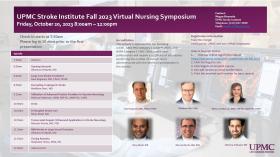
UPMC Stroke Institute Fall 2023 Virtual Nursing Symposium
The UPMC Stroke Institute Fall 2023 Virtual Stroke Symposium is designed to provide the most recent advances in stroke for nurses and health care providers including nurse practitioners and physician assistants. This event is to assist with educational requirements of nurses who work at certified stroke centers and to provide education to health care professionals who care for stroke patients.
Target Audience
This half day conference is geared towards nurses and other health care professionals who are affiliated with neurology, emergency medicine, neurosurgery and are working with patients through pre-, intra, and post-acute stroke care.
Learning Objectives
1. Develop the understanding of pre-hospital stroke care and the importance of communication.
2. Understanding the applications of transcranial dopplers in Stroke Neurology.
3. To become familiar with large core stroke treatments.
4. Discussion of mild stroke in large vessel occlusion.
5. Become familiar with cryptogenic stroke, the diagnostic work up, and potential etiologies.
Additional Information
| Attachment | Size |
|---|---|
 2023 Conference Outline.pdf 2023 Conference Outline.pdf | 153.52 KB |
Schedule
7:50am Check-in
Microsoft Teams
8:00am – 8:05am Opening Remarks
Alhamza Al-Bayati, MD
8:05am – 8:50am Large Core Stroke Treatment
Raul Nogueira, MD, FAHA, FSVIN
8:50am – 9:25am Decrypting Cryptogenic Stroke
Matthew Starr, MD
9:25am – 10:00am Topic
Rebecca Patterson, MSN, FNP-BC, ANVP-BC, CCRN
10:00am – 10:10am Break
Vanessa Beyer, RN
10:10am – 10:45am Prehospital Stroke Care
Nirav Bhatt, MD
10:45am – 11:20am Transcranial Doppler Ultrasound Applications in Stroke Neurology
Marcelo Rocha, MD
11:20am – 11:55am Mild Stroke in Large Vessel Occlusion
Alhamza Al-Bayati, MD
11:55am Closing Remarks
Stephanie Henry, MSN, RN / Alhamza Al-Bayati, MD
12:00pm Adjournment
Virtual Only
Course Directors
Stephanie Henry, MSN, RN – Program Director, UPMC Stroke Institute, Pittsburgh, PA
Rebecca Patterson, MSN, FNP-BC, ANVP-BC, CCRN - UPMC Stroke Institute, Pittsburgh, PA
Alhamza Al-Bayati, MD – Assistant Professor of Neurology & Neurosurgery, UPMC Stroke Institute, Associate Director, Neuroendovascular & Stroke Fellowship, Director, Pediatric Endovascular Surgery, Co-Director, Pediatric Endovascular Center of Excellence
Invited Faculty
Stephanie Henry, MSN, RN
Program Director, UPMC Stroke Institute
Rebecca Patterson, MSN, FNP-BC, ANVP-BC, CCRN
UPMC Stroke Institute
Alhamza Al-Bayati, MD
Assistant Professor of Neurology & Neurosurgery, UPMC Stroke Institute
Associate Director, Neuroendovascular & Stroke Fellowship
Director, Pediatric Endovascular Surgery
Co-Director, Pediatric Endovascular Center of Excellence
Nirav Bhatt, MD
Assistant Professor of Neurology
Director, Comprehensive Stroke Center, UPMC Presbyterian Stroke Program
Raul Nogueira, MD, FAHA, FSVIN
Director, UPMC Stroke Institute
Endowed Professor & Division Chief of Cerebrovascular Medicine
Professor of Neurology & Neurosurgery, University of Pittsburgh, School of Medicine
Marcelo Rocha, MD, PhD
Assistant Professor of Neurology
Director, NIH StrokeNET Research Fellowship
Pepper Scholar
Matthew Starr, MD
Assistant Professor of Neurology
Associate Director, UPMC Stroke Institute
Director, Comprehensive Stroke Center, UPMC Mercy
Director, Primary Stroke Center, UPMC Shadyside
Director, Vascular Neurology Fellowship
Vanessa Beyer, RN
UPMC Mercy Stroke Clinic
Faculty Disclosure
All individuals in a position to control the content of this education activity have disclosed all financial relationships with any companies whose primary business is producing, marketing, selling, re-selling, or distributing healthcare products used by or on patients.
All of the relevant financial relationships for the individuals listed below have been mitigated:
Raul Nogueira, MD
Consultant: Anaconda, Biogen, Cerenovus, Genentech, Philips, Hybernia, Imperative Care, Medtronic, Phenox, Prolong Pharmaceutical
Stockholder (privately held): Astrocyte, Brainomix, Cerebrotech, Ceretrieve, Corindus Vascular Robotics, Vesalio, Viz-AI, RapidPulse and Perfuze
No other members of the planning committee, speakers, presenters, authors, content reviewers and/or anyone else in a position to control the content of this education activity have relevant financial relationships with any companies whose primary business is producing, marketing, selling, re-selling, or distributing healthcare products used by or on patients.
In support of improving patient care, the University of Pittsburgh is jointly accredited by the Accreditation Council for Continuing Medical Education (ACCME), the Accreditation Council for Pharmacy Education (ACPE), and the American Nurses Credentialing Center (ANCC), to provide continuing education for the healthcare team.
Physician (CME)
The University of Pittsburgh designates this live activity for a maximum of 3.75 AMA PRA Category 1 Credits™. Physicians should claim only the credit commensurate with the extent of their participation in the activity.
Nursing (CNE)
The maximum number of hours awarded for this Continuing Nursing Education activity is 3.75 contact hours.
Physician Assistant (AAPA)
The University of Pittsburgh has been authorized by the American Academy of PAs (AAPA) to award AAPA Category 1 CME credit for activities planned in accordance with AAPA CME Criteria. This activity is designated for 3.75 AAPA Category 1 CME credits. PAs should only claim credit commensurate with the extent of their participation.
Other health care professionals will receive a certificate of attendance confirming the number of contact hours commensurate with the extent of participation in this activity.
Available Credit
- 3.75 AAPA Category I CME
- 3.75 AMA PRA Category 1 Credit™The University of Pittsburgh School of Medicine is accredited by the Accreditation Council for Continuing Medical Education to provide continuing medical education for physicians.
- 3.75 ANCCUPMC Provider Unit is accredited as a provider of continuing nursing education by the American Nurses Credentialing Center’s Commission on Accreditation
- 3.75 Attendance